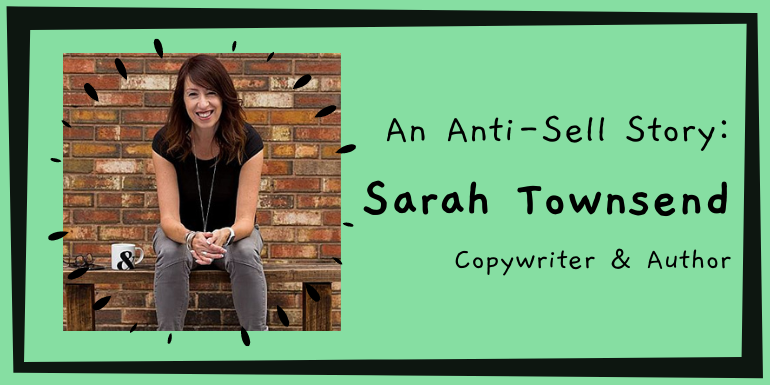
It’s been a while (October 2020) since I last published an Anti-Sell Story on the blog – but what a comeback!
This time I’m honoured to be interviewing Sarah Townsend, who’s a long-term freelance copywriter as well as the Amazon bestselling author of Survival Skills for Freelancers. In this interview we talk about her approach to networking and sales across her long-standing freelance career…
A few highlights from Sarah’s Anti-Sell Story:
- Sarah’s found that being a guest interviewee on podcasts has been a great way to promote herself as a freelancer as well as to promote her book. Her approach is to proactively volunteer herself as a guest, rather than necessarily waiting for people to invite her on instead.
- Show a genuine interest in everyone you meet. In other words, don’t just hone in on the people who you think would be your dream clients. After all, you never know who knows who – and someone who may not be your dream client may know and introduce you to a dream client…
- Confidence! I was surprised to hear that Sarah struggled with confidence when she was younger (and still does to an extent) – but “the more you do things, the better you get.”

Steve Morgan: Hi Sarah! First off: please introduce yourself! Who are you and what do you do?
Sarah Townsend: I’m Sarah Townsend, freelance copywriter for 20+ years and bestselling author of Survival Skills for Freelancers.
Steve: Why did you decide to go self-employed?
Sarah: I was working for a magazine publisher in Bristol when I became pregnant. This was 1999 – long before employers had to accommodate flexible working – and I knew I didn’t want to return to work five days a week. My then husband had a well-paid job so we decided it was a great opportunity for me to start working for myself just a couple of days a week while my baby was in nursery. I thought I had everything I needed to succeed as a freelancer: skills I could outsource, and a natural drive and determination. I had no idea how tough it’d actually be!
Steve: How did you find your first few clients?
Sarah: When I started out there was no LinkedIn or social media – there was barely any Internet! I contacted the few people I knew through previous jobs to let them know I’d gone freelance, but other than that I relied on cold enquiry letters to local businesses I knew I could help. Most fell on deaf ears but one or two stuck and it grew from there.
Steve: How do you market yourself these days?
Sarah: I don’t, really. Most of my work comes from word of mouth and recommendation. The rest comes through my website. I’m pretty hot on asking for testimonials – because I know they work for me – I’m consistently active on social media, and I have a monthly newsletter that enables me to keep in touch with my audience. In terms of the speaking, mentoring and training I’ve done since self-publishing Survival Skills for Freelancers, much of that has come from the 30+ podcast interviews I’ve done. I love to talk, so that bit’s easy!
Steve: Wow, that’s a lot of podcast interviews! How did they all come about? Did you approach them asking to guest, did they approach you, or was it a bit of both?
Sarah: A mixture of the two, though I’m pretty proactive when it comes to volunteering! Funny to think that I’d been approached for podcast interviews before Survival Skills for Freelancers but never had the confidence to say yes.
Steve: I’m really surprised to hear that actually. I’ve known you for a few years now and I’ve always thought of you as a very confident person. What changed? What’s made you more confident nowadays compared to your past self? Do you have any tips to share with those who struggle with confidence – especially the confidence to put themselves forward to things (such as podcast interviews)?
Sarah: People generally do, I think, but I was always the shy kid in school and never had the confidence to put myself forward for anything. I’ve spent so many years doing the whole “fake it till you make it” thing that some of the confidence has rubbed off, but it’s really very fragile. I find it helps to focus on the other person, rather than your own feelings. And there’s a lot to be said for just putting yourself out there and grasping opportunities that come your way.
The confidence boost that comes from doing something that’s outside your comfort zone is fantastic – and, of course, the more you do things, the better you get. Any time my kids had to do anything brave – taking part in a school play, or being interviewed for a job – I always told them the same thing. “Those nerves and feelings of anxiety feel a lot like excitement. Tell yourself you’re excited to be doing something new and different and you’re far more likely to enjoy the experience, and to do it well.”
Steve: Going back to podcasts… What types of topics do the podcasts cover? Are they all mostly about freelancing, or are some of them quite varied/broad topic-wise?
Sarah: They’re usually related to business or personal development in some way. Some focus on female entrepreneurs, others on digital marketing, some on creativity, others on freelance life…
“I’m pretty hot on asking for testimonials – because I know they work for me.”
Steve: Has there been a particular marketing or networking tactic that’s worked really well for you?
Sarah: Having a quality website is an essential starting point. Once that’s up and working for you, it’s all about building relationships. We spend so much time creating our customer profiles that it’s easy to go into a networking event, scan the room and quickly decide we don’t see our dream client. The problem is, we disengage and miss opportunities as a result. Think about the ripple effect, and remember that you never know who the person you’re talking to is connected to. If you show a genuine interest in them and their business – and make a great impression – chances are it’ll come back to you in some way.
Steve: What’s the most roundabout way you’ve gotten a really good enquiry?
Sarah: I can think of two…
1) The MD of an IT company found me indirectly when he Googled the answer to a grammar question. I have heaps of content on my website (probably too much, if anything!). He loved the plain English way I solved his problem and decided to book a discovery call while he was there. We clicked, and I’ve worked for his business ever since – including writing three websites!
2) Long story short, I was heading to Cheltenham for a meeting when I got chatting to a lady at the bus stop. We ended up sitting together on the bus and she told me her son was a graphic designer and new to the area. I gave her my card and told her to suggest getting in touch. He and I have become good friends and he’s since introduced me to two major clients.
(I’ve even worked with someone I met in the sauna at my gym. That’s a whole other story 😃)
Steve: What advice would you give to your younger self – the version of you who’d only just gone self-employed?
Sarah: That’s easy. Buy Survival Skills for Freelancers! I set out to write a book that contained all the advice and support that 29-year-old me would’ve loved when I started my journey into self-employment. When I read the reviews saying how it’s helped people – and just how many say they wish they’d read it when they first became self-employed – I feel like I achieved what I set out to do. And that makes me happy.
“Having a quality website is an essential starting point. Once that’s up and working for you, it’s all about building relationships.”
Steve: Tell us about the book!
Sarah: It condenses 20+ years of experience – plus quotes from more than 100 freelancers – into 200 easy-to-read pages. It covers the practical side of self-employment (brand, finances, productivity, time management and the like) with a focus on YOU, your wellbeing and your mindset. By setting better boundaries, you can achieve a better work-life balance, avoid burnout and get a lot more enjoyment from self-employment.
Sarah Townsend is a freelance copywriter and the Amazon bestselling author of Survival Skills for Freelancers. Follow Sarah on Twitter and LinkedIn.